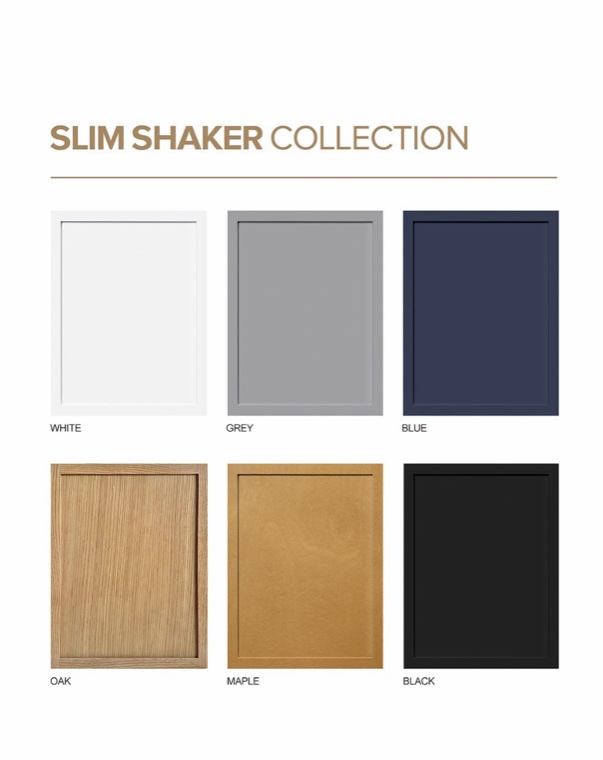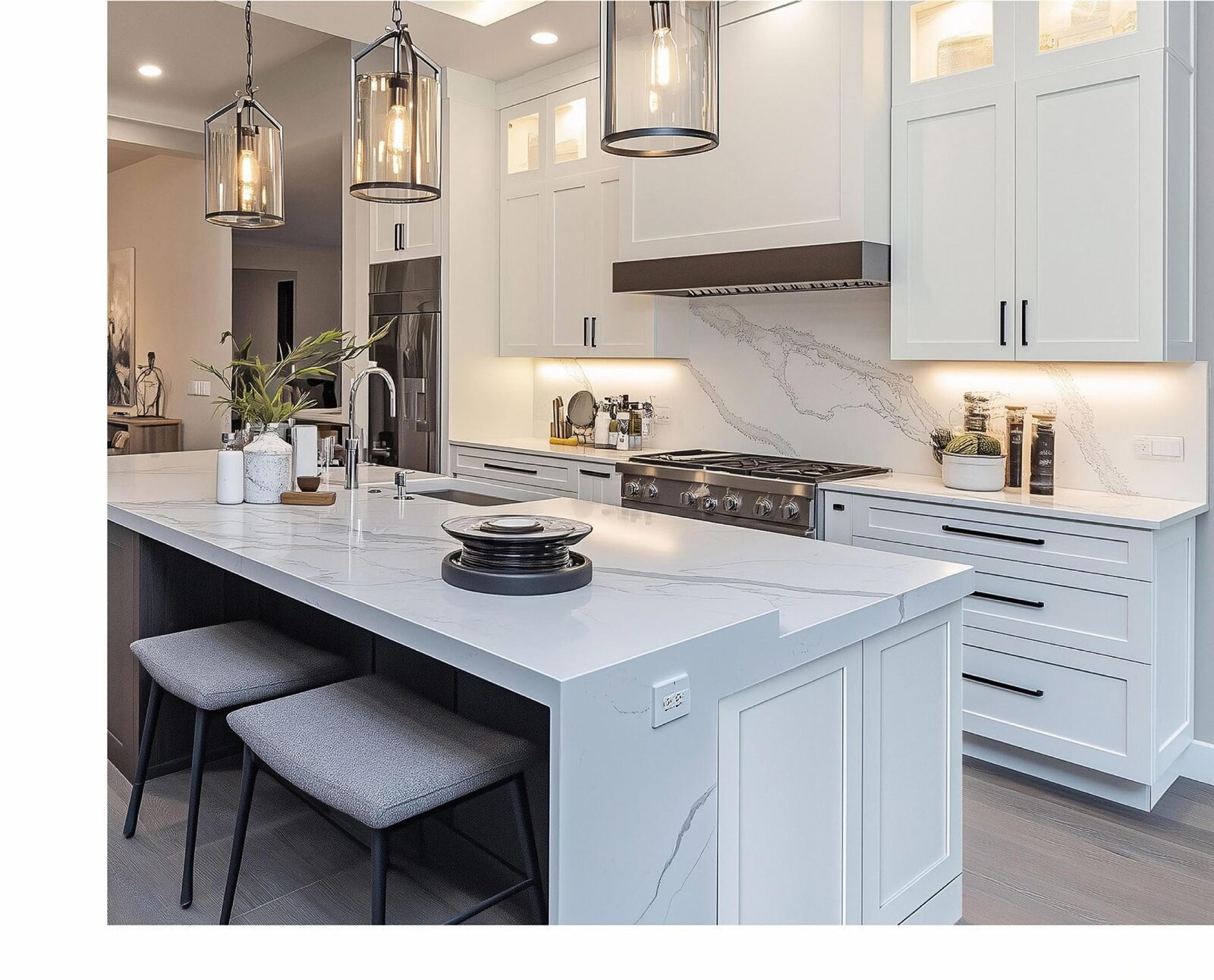
The best way to choose kitchen cabinet colors is to start with what you cannot change, then test your short list in your own light. Your floor, counters and windows set the limits. Samples, viewed over a full day, make the final call.
Here is the order we suggest. It keeps the choice small and easy to check.
Start with the floor and counters
Look at the floor and the counter first. Both are expensive to swap, so the cabinet color should fit them, not the other way around. This Old House advises counting the countertops, backsplash and flooring in the decision so the room feels like one space.
Ask two questions about each surface.
- Is it warm (yellow, red, orange) or cool (blue, gray, green)?
- Is it light or dark?
Try to stay in one family, warm or cool, across the floor, counter and cabinets. Mixing a little is fine. Mixing a lot tends to look accidental. That is our rule of thumb, not a hard standard, so trust your eye and your samples over it.
Contrast helps too. Family Handyman says that when walls and cabinets are both dark, a lighter floor or a light counter gives the room some relief. This Old House makes a similar point: pale counters and backsplash keep dark cabinets from feeling heavy.
Think about the light in the room
A cabinet color is never one color. It changes with the light that hits it.
Natural light comes from your windows. Artificial light comes from your bulbs. Benjamin Moore says both change how a color looks, which is why it tells buyers to check colors from morning to evening.
Some practical points:
- Dark colors need light. Family Handyman says dark cabinets need plenty of natural light, and that lighting matters more in a dark kitchen. Under-cabinet lights help.
- Light colors suit small kitchens. The same article says white cabinets tend to make a small kitchen feel larger.
- Bulb color matters. The U.S. Department of Energy lists 2,700 K as a warm light and 4,100 K as a cool one. A big jump between the two is noticeable. A warm bulb pulls out yellow in a cabinet. A cool bulb pulls out blue or gray.
Before you test anything, decide which bulbs will be in the kitchen. If you plan to change them, change them first. Otherwise your samples will look different after the new bulbs go in.
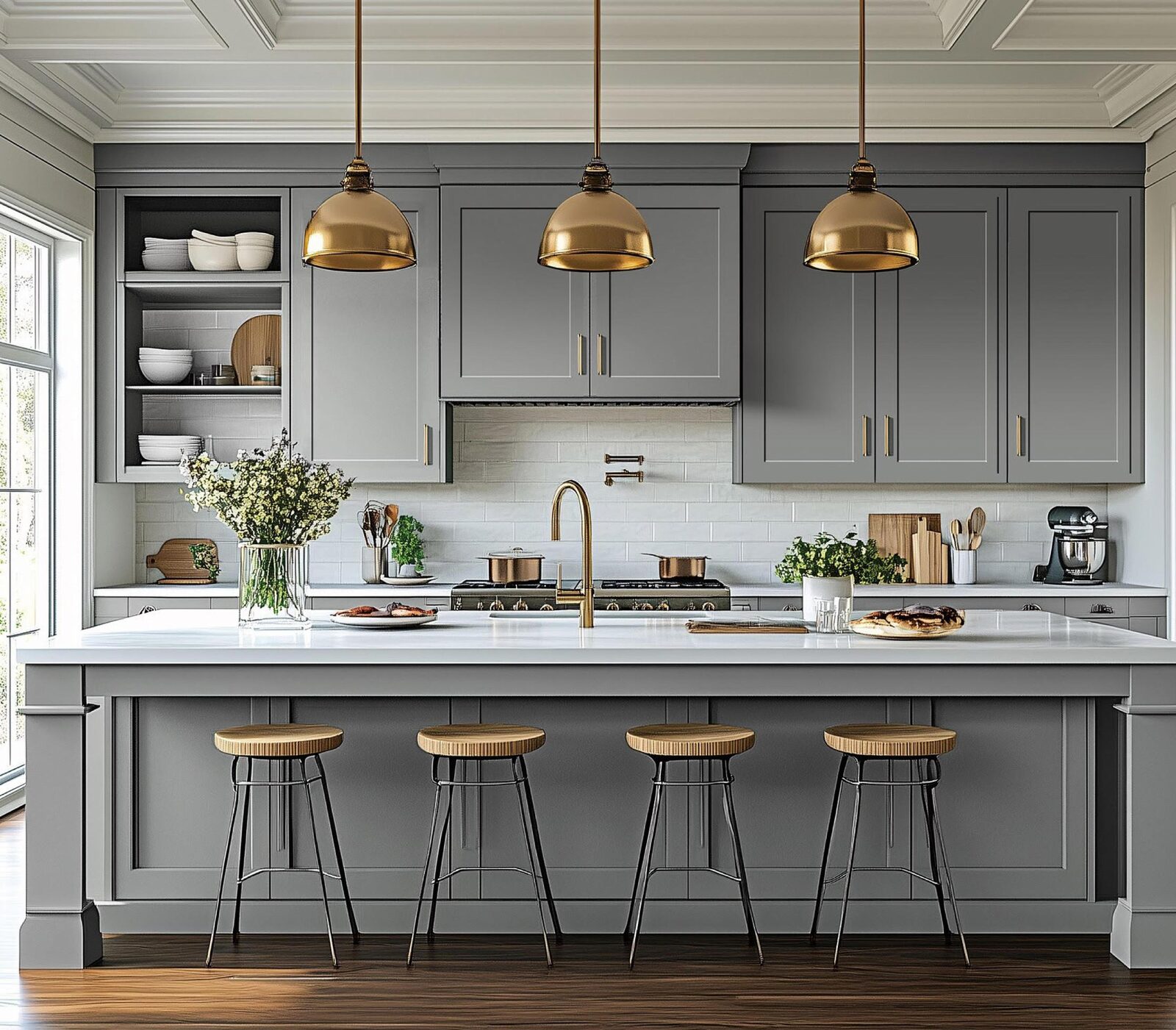
How to judge samples
Small chips lie. They are tiny, and the color around them changes how they look. Use the largest sample you can get.
Benjamin Moore gives these steps, and they work for any finish:
- Put chips against a white sheet of paper so the wall color does not skew them.
- Hold chips up against the wall instead of looking down at them.
- For liquid samples, brush on at least two coats.
- Paint a white foam board, not the wall, so you can move it around the room.
- Check it from morning to evening, in daylight and under your lamps.
We add a few steps of our own.
- Set the sample next to a piece of your floor and your counter. If you cannot move them, take a photo of the sample in place and a photo of the counter in the same light.
- Stand the sample upright, the way a door would stand. Cabinet doors are vertical, and light hits them differently than a flat surface.
- Look at it at night. Many people cook and clean in the evening.
- Leave it up for a few days. Your first reaction is not always the one you keep.
Keep in mind that a paint sample shows paint. A wood-look finish or a door with a profile will read differently because of grain and shadow. If you are choosing a door style as well, look at our door styles and compare them in the same light.
Narrow it down
After testing, you should have one or two colors left. Use this short list to pick one.
- Which one still looks right at 8 a.m. and at 8 p.m.?
- Which one sits well with the floor, with no clash in warmth?
- Which one works with the counter without fighting its veining or pattern?
- Which one can you live with every day, including how it looks with fingerprints, crumbs and splashes?
If two colors tie, choose the one that is closer to your floor family. It is the safer match.
Hardware is the last piece. Pick handles after the cabinet color is set, and hold them against your sample in the same light.
Where we come in
We make this part simpler with a layout you can look at before you order. Design help is free. You send measurements and photos, or start your design on our site, and we draw the layout in 3D for you to check.
To get started, send us:
- Your room measurements, including windows and doors.
- Photos of the floor, counter and walls in daylight.
- The color or finish you are leaning toward, and the runner-up.
You can browse the full range on our kitchen cabinets page. Our cabinets are RTA, ready to assemble. We do not assemble or install them. Our shaker kitchen lines use a 1/2 inch cabinet-grade plywood box with a UV-coated interior, and solid-wood dovetailed drawer boxes; the frameless line uses a 3/4 inch plywood box and drawer boxes in white melamine. Lead time is about 7 days. Shipping within the US then takes 3 to 7 days, depending on your location. For custom work we confirm the production time when the order is placed.
So get your samples, give them a full day of light, and send us the photos. We will help you work out the layout from there.
Sources
- How to Use Paint Color Samples (Benjamin Moore): sample testing steps, light timing
- How to Choose Paint Colors For Your Interior (Benjamin Moore): natural and artificial light change color
- Purchasing Energy-Efficient Light Bulbs (U.S. DOE FEMP): bulb color temperature, 2,700 K vs 4,100 K
- Kitchen Color Showdown: Dark vs. White (Family Handyman): dark cabinets, light, floors, small kitchens
- 12 Kitchen Cabinet Color Combinations (This Old House): coordinating counters, backsplash, floor