Cabinet delivery what to expect, in short: your cabinets arrive as ready-to-assemble boxes, you check them against the packing slip before the driver leaves, you write any damage on the paperwork before you sign, and you store everything indoors until assembly. The check at the door takes about 15 minutes and saves a lot of trouble later.
Below is how it works, step by step.
How the order gets to you
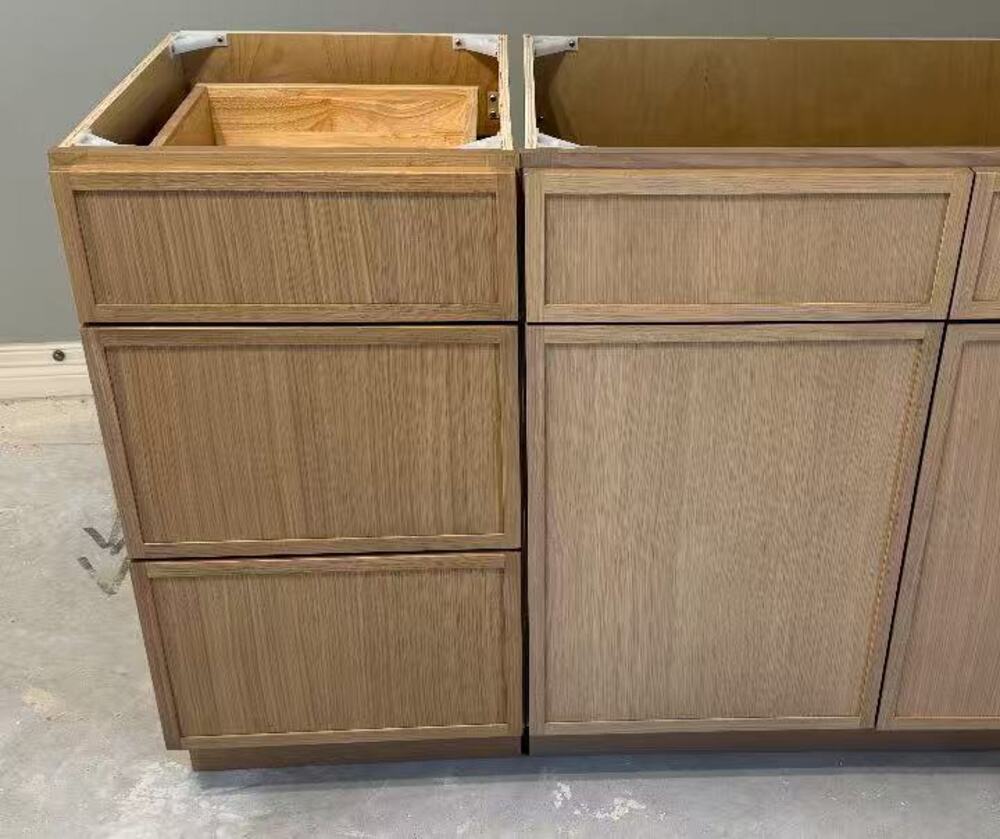
Our cabinets are RTA, ready to assemble. We do not assemble or install them, so they travel as boxed parts, not as built units.
Lead time is about 7 days. Shipping within the US then takes 3 to 7 days, depending on your location. We ship from Houston and U.S. warehouses. For custom work we confirm the production time when the order is placed.
A bigger order, like a full kitchen, usually comes by freight carrier. That means a truck, a driver and a delivery window. Ask the carrier what the delivery includes, so you know whether the boxes stop at the curb or come to the door. Either way, count on a lot of weight. Plan where the boxes will go before the truck shows up.
Before delivery day
A few things to sort out ahead of time:
- Pick a storage room. Use a clean, dry room inside the house. Ideally it is on the same level as the kitchen, so you do not carry heavy boxes on stairs. KraftMaid gives this advice in its delivery prep guide.
- Clear the path. Move cars, furniture and anything in the way of the door.
- Have a helper. You may need a second person to move boxes inside.
- Keep your phone charged. You will want photos.
- Find your order list. Keep your order confirmation handy so you can match it to the packing slip.
If you have not finished your layout, start your design first. It is much easier to check boxes against a drawn plan than against a guess.
What to do when the driver arrives
Do the check before you sign. Once the driver leaves, it is harder to show that damage happened in transit.
- Match the order. Compare the cartons with the driver's packing slip and your order. Each carton has a label with its item code. One box can carry more than one label if it holds several items.
- Count the pieces. Make sure the count matches the paperwork.
- Look at the outside of every box. Check for tears, bent corners and water stains. KraftMaid's guide says to ask the driver to open any package that shows such signs.
- Take photos. Photograph the pallet or boxes as they arrive, then close up on any problem.
- Write it down. Note damaged or missing items on the packing slip or delivery receipt before you sign. Be specific. "Two cartons crushed on one corner" says more than "damaged."
You may not have time to open every box at the door. That is fine, and the next section covers it.
Check the boxes after the driver leaves
Some damage only shows once you open a carton. This is called concealed damage. Do not wait on it.
Carrier rules differ. Old Dominion Freight Line, for example, asks that damage not visible at delivery be reported within five business days after the freight arrives. Other carriers set their own deadlines. Treat the shortest one as your deadline.
So open and inspect the boxes in the first day or two. Here is a simple routine:
- Open each carton carefully, with a blade set shallow so you do not scratch the parts inside.
- Check doors, panels and drawer boxes for chips, cracks and bent edges.
- Check the hardware bags against the parts list.
- Keep all packaging, including damaged cartons, until any claim is closed. Old Dominion says to do this for both visible and hidden damage.
- Photograph the damage with the box label in the shot.
Then send us the photos and the label codes. We will help you work out what to do next.
Storing cabinets before assembly
Store the boxes indoors, in the house, not in the garage. KraftMaid's guide says indoor storage protects cabinets from moisture and temperature swings, and lets them adjust to your home.
There is a simple reason for this. Penn State Extension explains that wood keeps taking on or giving up moisture until it matches the air around it. Wood stored where the air is damper or drier than your home will change size, and that can open joints or cause warping. Penn State's example is lumber at 70°F: about 7.7 percent moisture at 40 percent humidity, and about 14.9 percent at 77 percent humidity. A garage or shed can swing far outside the range of a heated house.
Some practical rules:
- Keep them dry and clean. A spare room or a dry basement works if it is not damp.
- Stay out of the way. Pick a spot with little foot traffic, so boxes do not get kicked or tipped.
- Protect your floors. Lay moving blankets, a tarp or rugs under the boxes.
- Stack with care. If you must stack, put the smaller, light boxes on top.
- Leave parts in their cartons. Open only what you need to check, then reseal or cover.
Once the room is ready and you are ready to build, move the boxes you need into the work area.
Where we come in
We draw your layout in 3D for free, so you know exactly what should be in the boxes. Design help is free. You send measurements and photos, or start a design on our site, and we draw the layout in 3D for you to check.
If you are still choosing, browse our kitchen cabinets.
When your order arrives, send us:
- A photo of the packing slip and the delivery receipt.
- Photos of any damaged box, with the label showing.
- A short note of what is wrong and which item code it is.
The sooner we see it, the sooner we can sort it out with you.
Sources
- Penn State Extension: Understanding equilibrium moisture content: wood moisture change, why indoor storage matters
- KraftMaid: Preparing for delivery: checking delivery, noting damage, indoor storage
- Old Dominion Freight Line: Cargo claims FAQ: concealed damage five business days, keep packaging